Canada’s Nuclear Workforce Is at a Turning Point — Here’s How PTAG Is Responding
PTAG Workforce Development Practice | Insights
By Rachel Sumner, Senior Director — Workforce Development, PTAG
The Stakes Have Never Been Higher for Canadian Nuclear
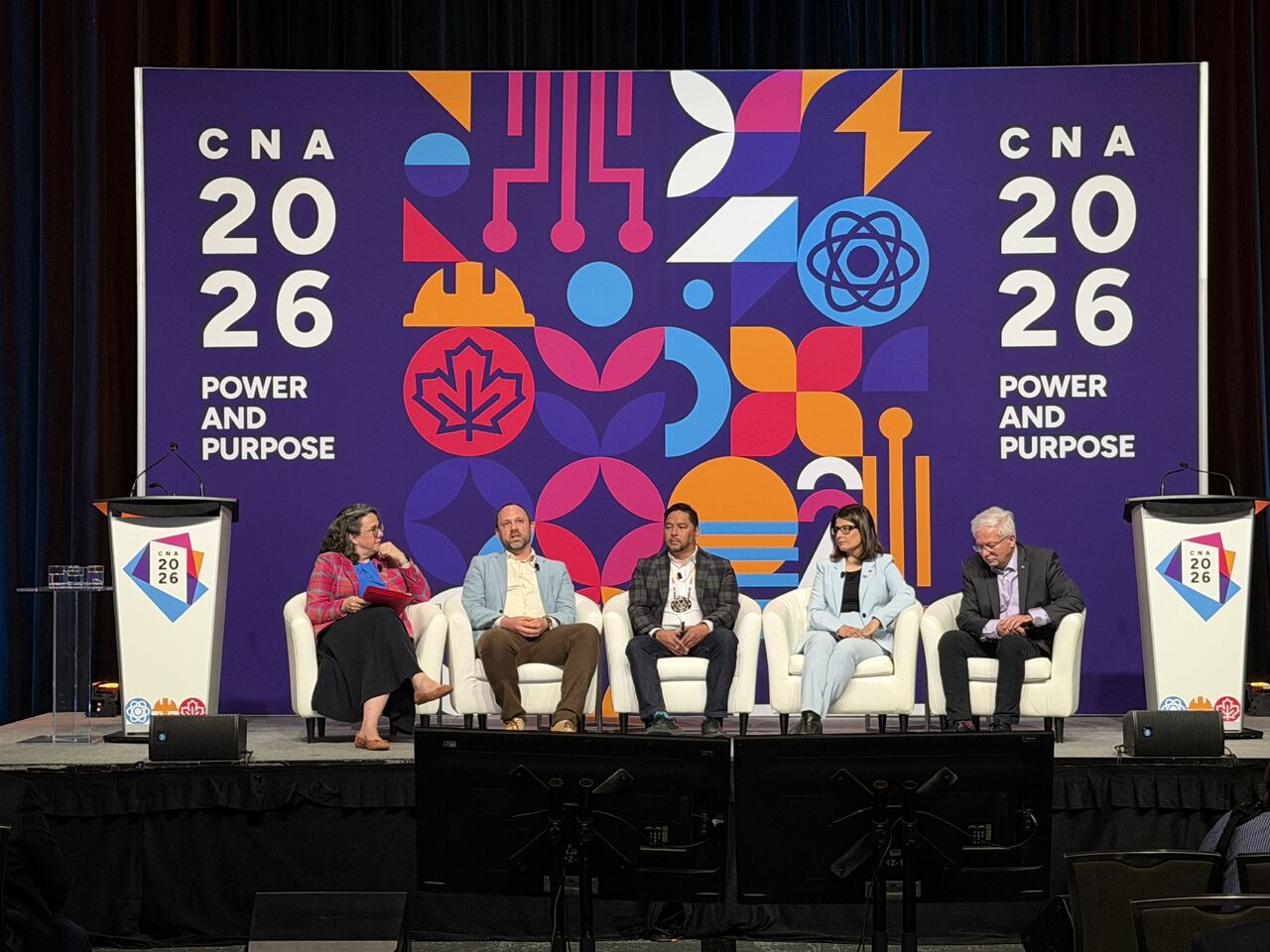
The Canadian Nuclear Association’s newly released MADE for Nuclear Workforce Development Strategy puts numbers to what many in Canada’s nuclear sector have sensed for years: the country faces a structural, nuclear-specific workforce crisis that, if unaddressed, will determine whether Canada’s most ambitious clean energy buildout in a generation succeeds or stalls.
The CNA’s companion data report is unambiguous. Under the planned and signalled scenario, 22.3 GW of new nuclear capacity across Ontario, Saskatchewan, New Brunswick, and Alberta, workforce shortages begin in earnest in 2030 and deepen through the early 2040s. The most acute gaps fall in ironworking (an average annual shortfall of 1,249 workers), trades helpers and labourers (1,072), steamfitting and pipefitting (726), and mechanical engineering (573). These are not niche specializations. They are the bedrock occupations of any large-scale construction program.
And yet the problem is not simply one of numbers. It is structural. Canada’s credentialing systems, education pipelines, inter-provincial labour mobility frameworks, and talent attraction practices were not designed for a nuclear renaissance. The MADE strategy is built on four pillars which charts a course for transforming those systems. It is ambitious, comprehensive, and right.
PTAG’s new Workforce Development Practice was built for just such a purpose: to help Canadian nuclear sector organizations turn the MADE strategy into operational reality.
What the MADE Strategy Gets Right, and Why It Demands a Different Kind of Partner
The MADE framework is notable for what it does not do: it does not treat the workforce challenge as a simple hiring or training problem to be handed off to HR departments. It recognizes that the crisis is systemic, and that the response must be equally systemic. It spans credential recognition, public perception, institutional education reform, Indigenous community partnerships, and long-horizon succession planning.
This framing has important implications for how Canadian nuclear organizations should seek support. What is needed are partners who can operate at the intersection of workforce strategy, project execution, and stakeholder engagement, and who understand the Canadian nuclear sector and its regulatory, supply chain, and labour landscape well enough to translate strategy into site-level and program-level action.
That is precisely the mandate of PTAG’s Workforce Development Practice.
PTAG’s Response to Each MADE Pillar
Pillar 1: Mobility – Unlocking Cross-Sector and Inter-Provincial Talent
The MADE strategy calls for nuclear career crossover pathways, reciprocal recognition agreements, a national labour-pool coordination function, and a centralized nuclear job board. The underlying challenge is that Canada’s fragmented credentialing landscape and absence of inter-provincial portability for nuclear qualifications creates friction that directly delays project staffing.
PTAG brings to this challenge our deep knowledge of adjacent Canadian high-hazard industries, oil and gas, mining, and large-scale infrastructure, that hold significant pools of transferable trades and engineering talent for nuclear, and our track record of moving those workers into nuclear-ready roles.
We help nuclear project owners and operators identify transferable competency profiles from those industries, design bridging programs that accelerate qualification, and build the workforce planning infrastructure needed to coordinate labour supply across project phases and provincial boundaries. As Bill C-5 begins reshaping the inter-provincial mobility landscape, PTAG can help organizations position themselves to benefit from that shift rather than waiting for it to resolve.
For new-to-nuclear jurisdictions like Alberta and Saskatchewan, where nuclear-specific workforce density is near zero, PTAG’s work in developing skills-based workforce strategies offers a direct path to building a local talent pipeline without waiting for a domestic nuclear culture to develop organically.
Pillar 2: Attraction and Retention – Making Nuclear a Career of Choice
The MADE strategy correctly identifies that low public awareness and a poorly defined career narrative are significant barriers to workforce growth, particularly in communities and demographics that have had limited exposure to the sector. The proposed “Powering Canada” campaign, experiential outreach programming, an ambassador network, and structured succession planning each address a distinct failure point in the current attraction and retention ecosystem.
PTAG’s Workforce Development Practice approaches attraction and retention from an employer and program design perspective. We help nuclear organizations articulate and operationalize compelling employee value propositions, design structured onboarding and development pathways that make career progression visible and achievable, and build succession planning frameworks that protect continuity through the coming wave of retirements.
We are particularly focused on the succession dimension. The CNA data shows that over 25% of the nuclear workforce will reach retirement age by 2030-2035. The institutional knowledge embedded in those workers, knowledge that took decades to accumulate in licensed operations, reactor maintenance, and regulatory affairs, cannot simply be re-hired. PTAG helps organizations identify critical knowledge holders, design structured knowledge transfer programs, and build the next generation of leadership before the attrition crisis arrives.
Pillar 3: Expanding the Talent Pool – Indigenous Partnerships in Canadian Nuclear
The MADE strategy makes a strong case that the Canadian nuclear sector’s talent gap cannot be closed without expanding the communities from which the workforce is drawn – particularly Indigenous communities near proposed nuclear sites and the rural and underserved regions of Saskatchewan and Alberta where local nuclear workforce density is near zero.
For nuclear project developers in those jurisdictions, Indigenous community relationships are not peripheral to workforce strategy — they are central to project social licence and to accessing the local talent pools essential where a nuclear workforce does not yet exist. PTAG approaches this as an operational requirement, not a programmatic add-on.
PM7G, PTAG’s joint venture with Makhos Staffing Solutions, is a Certified Indigenous Business recognised by the Canadian Council for Indigenous Business (CCIB). The venture combines PTAG’s technical depth in large-scale project management with Makhos’ leadership in Indigenous professional services. In 2025, PM7G was selected by Ontario Power Generation under a multi-year Vendor of Record agreement to provide project controls, project management, and construction management services — making it one of the few Indigenous-certified businesses operating at the heart of Canada’s nuclear program.
PM7G is also actively building the next generation of Indigenous project professionals through training partnerships with Ontario Tech University, Centennial College, and Lambton College, with customised programs designed to grow Indigenous participation in project delivery careers. This is exactly the kind of education-to-employment pathway the MADE strategy calls for: community-connected, employer-backed, and tied to real job opportunities on real Canadian nuclear projects.
PTAG brings this same approach to every Canadian nuclear workforce engagement: Indigenous participation embedded in project execution from day one, not retrofitted as a compliance exercise.
Pillar 4: Education and Skills Alignment – Building the Pipeline
The MADE strategy’s education pillar addresses both the near-term bottleneck, too few apprenticeship spots, too little nuclear-specific content in trades and engineering programs, too little practical experience in graduating engineers, and the longer-term structural challenge of aligning Canada’s post-secondary and vocational education systems with nuclear workforce demand.
The proposed Nuclear Foundation Pathways, early education and teacher engagement initiatives, industry-integrated educator development secondments, the Nuclear Skills Accord, and open educational resource repositories are each well-conceived interventions. The challenge, as the strategy acknowledges, is that many of these take years to fully operationalize.
PTAG helps nuclear organizations close the gap between where the education system currently is and where project timelines require it to be. We design competency frameworks, work with training providers to develop and fast-track nuclear-relevant programs, and build the internal training infrastructure, from simulation-based learning to structured on-the-job qualification programs, that project owners and operators need to develop job-ready workers from the available talent pool.
A Word on New-to-Nuclear Jurisdictions
The MADE strategy dedicates specific attention to the distinctive challenges facing provinces and territories without established nuclear programs. PTAG considers this the highest-urgency dimension of the current workforce landscape.
Saskatchewan and Alberta are moving on nuclear timelines that will require workforce readiness well before local ecosystems have time to develop organically. The lead times for qualifying nuclear professionals, the MADE strategy appendix notes five to ten years or more for certain licensed and senior technical roles, mean that the workforce development work must begin now, not when construction contracts are signed.
PTAG’s Workforce Development Practice can serve as the workforce planning and implementation partner for new-to-nuclear Canadian project developers and provincial governments navigating this challenge. We can help develop the comprehensive Human Resource Management strategies the IAEA framework calls for, design and execute the stakeholder engagement programs needed to build local trust and Indigenous partnerships in Canadian host communities, and create the education-to-employment pipelines that will give communities near proposed sites a genuine stake in the project’s success.
The Urgency Is Real
The CNA’s data report makes clear that the window to act is narrow. Workforce gaps in the planned and signalled scenario begin widening meaningfully in 2030. For the most critical skilled trades and engineering roles, the gap between supply and demand is not solved quickly , it is solved through years of sustained, structured effort to recruit, develop, and retain talent.
The MADE for Nuclear strategy provides the roadmap. Canada’s nuclear sector now needs partners with the capacity, the nuclear-specific sector knowledge, and the Canadian implementation experience to help organizations execute against it.
That is what PTAG’s Workforce Development Practice offers.
Work With Us
PTAG’s Workforce Development Practice is working with Canadian nuclear sector organizations — project developers, utilities, tier-1 contractors, new-to-nuclear provincial governments, and Indigenous community partners — to develop and execute workforce strategies aligned with the MADE framework.
If your organization is facing any of the following challenges, we want to hear from you:
- Developing a workforce strategy for a planned or signalled Canadian nuclear project
- Closing skills gaps in nuclear trades or engineering functions critical to construction or operations timelines
- Building succession plans to protect continuity through the wave of nuclear retirements arriving before 2035
- Designing Indigenous community workforce partnerships and training-to-employment pathways for nuclear sites
- Navigating inter-provincial labour mobility and credential recognition under Canada’s evolving nuclear workforce regime
- Aligning your organization’s nuclear talent pipeline with the MADE framework’s priorities and timelines
Connect with PTAG’s Senior Director – Workforce Development to start a conversation about your workforce challenges and how PTAG can help you meet them.
About the Author
Rachel Sumner is Senior Director – Workforce Development at PTAG, where she is building and leading the firm’s new Workforce Development Practice, PTAG’s latest addition to its service suite for capital and sustaining project clients across Canada and the United States.
Rachel brings an uncommon combination of credentials to this work: she is simultaneously a practitioner of workforce transformation at scale, a builder of education-to-employment systems, and an expert in the application of AI to workforce strategy. Her career spans executive leadership roles in post-secondary education, commercial workforce development, and strategic consulting, with a consistent thread of designing and delivering first-of-a-kind programs that create systemic, lasting change.
Most recently, Rachel founded Acuity AI, a boutique consultancy applying generative AI and human expertise to workforce transformation challenges. In that capacity she has been supporting the University Network of Excellence in Nuclear Engineering (UNENE) to develop a national professional development strategy to upskill and reskill thousands of workers in the Canadian nuclear industry, work that sits squarely at the intersection of the MADE framework’s Education and Skills Alignment pillar and the sector’s most urgent near-term needs.
Prior to founding Acuity AI, Rachel served as Chief Executive Officer of Ontario Tech Talent Inc., a multi-million dollar generating commercial subsidiary of Ontario Tech University, where she grew a team of 20+ to develop and deliver AI-supported, rapid-cycle, competency-based workforce training to Canadian employers. She has also held senior partnership and consulting roles at Pearson, The Conference Board of Canada’s Niagara Institute, Dalhousie University, and internationally in the UK.
Rachel holds a Master of Arts in Education, Curriculum, Training and the Future of Work from the Open University (UK); a Bachelor of Arts in Business Education with Qualified Teacher Status from the University of the West of England; a Bachelor of Science in Social Science and Economics from the Open University; a Postgraduate Certificate in Executive Coaching and Mentoring from the UK Institute of Leadership and Management; and an Agile Project Management certification.
She is based in Oakville, Ontario.
Rachel welcomes direct conversations with nuclear workforce leaders grappling with the challenges the MADE strategy describes. If the questions this paper raises are ones your organization is wrestling with, reach out.

Rachel Sumner
Senior Director – Workforce Development
PTAG is a project management and technical advisory firm supporting major capital projects across the energy, resources, and infrastructure sectors. PTAG’s Workforce Development Practice provides workforce strategy, planning, and implementation services to clients navigating complex talent challenges in capital-intensive industries.